
What’s the difference?
Grade 5 titanium and Grade 5 titanium alloy are generally the same material. The difference is mainly how the terms are used, rather than a difference in composition or performance.
1. Titanium (pure titanium)

Technically refers to commercially pure titanium, such as Grades 1–4.
-
Generally softer and more ductile than Grade 5.
-
Excellent corrosion resistance.
-
Often used in chemical processing, marine applications and medical products.
2. Grade 5 titanium alloy (Ti-6Al-4V)

A titanium alloy containing aluminium and vanadium to improve its mechanical properties.
-
High strength-to-weight ratio.
-
Stronger than commercially pure titanium.
-
Excellent corrosion resistance.
-
Good fatigue performance and heat resistance.
-
Commonly used in aerospace, motorsport and high-performance engineering.
Our fasteners are made from Grade 5 titanium alloy (Ti-6Al-4V), a high-performance material composed primarily of titanium, with aluminium and vanadium added to enhance its strength and mechanical properties. It offers an excellent strength-to-weight ratio, outstanding corrosion resistance and the premium finish ideal for automotive styling applications.
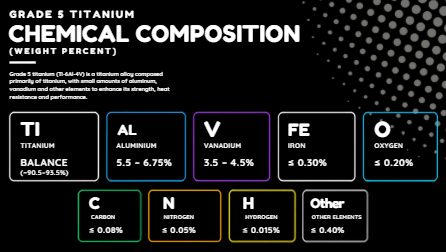
Grade 5 Titanium (Ti-6Al-4V) Composition
Balance – Titanium (Ti)
Titanium forms the primary matrix of the alloy, providing its excellent corrosion resistance, high strength-to-weight ratio, and low density.
6% – Aluminum (Al)
Function: Aluminum acts as an alpha (α) phase stabilizer.
Effect: It contributes to solid-solution strengthening, increasing the alloy’s tensile strength and improving its resistance to creep and deformation at elevated temperatures.
4% – Vanadium (V)
Function: Vanadium acts as a beta (β) phase stabilizer.
Effect: It lowers the alpha-to-beta transformation temperature and helps stabilize the beta phase. This contributes to improved toughness, fatigue strength, and heat-treatment response, allowing the alloy’s mechanical properties to be tailored through controlled heat treatment.
Trace & Controlled Elements
Elements such as Iron (Fe), Oxygen (O), Nitrogen (N), and Hydrogen (H) are carefully controlled within specified limits.
Oxygen is particularly important because it can increase strength and hardness at controlled levels, but excessive oxygen content can reduce ductility and lead to embrittlement.
No. Grade 5 Titanium (Ti-6Al-4V) is non-magnetic, similar to commercially pure titanium.
Yes. Grade 5 Titanium is particularly well suited to anodizing, making it popular for automotive, motorsport, cycling, and custom applications.
Grade 5 Titanium offers an impressive combination of high strength, low weight, corrosion resistance, and heat resistance. Combined with its ability to be anodized in a range of colours, it provides both functional and visual benefits — making it an excellent choice for performance and automotive styling applications.
Not quite, titanium has a very high resistance to corrosion and rust unlike like steel. When exposed to oxygen, titanium naturally develops a thin, stable protective oxide layer on its surface. This passive layer provides excellent resistance to corrosion, including exposure to moisture, saltwater, sweat, and many corrosive environments.