
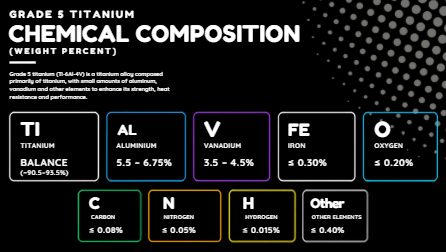
Grade 5 Titanium (Ti-6Al-4V) Composition
Balance – Titanium (Ti)
Titanium forms the primary matrix of the alloy, providing its excellent corrosion resistance, high strength-to-weight ratio, and low density.
6% – Aluminum (Al)
Function: Aluminum acts as an alpha (α) phase stabilizer.
Effect: It contributes to solid-solution strengthening, increasing the alloy’s tensile strength and improving its resistance to creep and deformation at elevated temperatures.
4% – Vanadium (V)
Function: Vanadium acts as a beta (β) phase stabilizer.
Effect: It lowers the alpha-to-beta transformation temperature and helps stabilize the beta phase. This contributes to improved toughness, fatigue strength, and heat-treatment response, allowing the alloy’s mechanical properties to be tailored through controlled heat treatment.
Trace & Controlled Elements
Elements such as Iron (Fe), Oxygen (O), Nitrogen (N), and Hydrogen (H) are carefully controlled within specified limits.
Oxygen is particularly important because it can increase strength and hardness at controlled levels, but excessive oxygen content can reduce ductility and lead to embrittlement.

Leave A Comment